Family entered 1970 with Roger Chapman, Charlie Whitney, John Weider, Poli Palmer and Rob Townsend. A Song for Me, released on 23 January, reached UK No. 4 and gave the reconfigured band its strongest album placing. “Today” followed on 1 May, and the three-track Strange Band EP (Reprise RS 27009) appeared on 31 July, reaching UK No. 11.
Touring stretched across Britain, continental Europe and the United States, with major festival appearances at Kralingen, Bath and the Isle of Wight alongside BBC and European television work. The half-live, half-studio Anyway arrived in November and reached UK No. 7; no unsupported day is imposed on that release.
January 197012 events
Radio Session
Thursday · 1 January 1970
BBC Sunday Show (John Peel), Paris Cinema
Lower Regent Street, London SW1, England
Broadcast: Sunday 04 January 1970. Set: '93's O.K. J' (instrumental) · 'Here Comes the Grin' (instrumental). Recorded at the BBC's Paris Cinema for John Peel's Sunday Show. Minutes before airtime Roger Chapman was struck down with flu, leaving the group to perform two instrumentals and spinning tracks straight off the new album while Peel hastily brought in Tyrannosaurus Rex to fill the bill. Both performances were later officially released on BBC Radio Volume 3 – 1970 and At the BBC.
“Family's singer Roger Chapman was taken ill before the broadcast, but the band played on without him, turning in two fierce instrumentals that kept the audience on its toes.”
— Evening Sentinel, 6 January 1970
Underground Music Festival 'Opération 666', L'Olympia
28 bd des Capucines, Paris, France
Family played the two-night Underground Music Festival at L'Olympia on 8 and 9 January 1970, sharing a French/British progressive-rock bill that also included Zoo, Trapeze, Colosseum and the Moody Blues. The dates were the band's first live work of the new decade and kicked off the A Song for Me promotional push in the week before the LP's UK release.
Opening night of the three-day Paris 'underground' fest (Moody Blues headlined 9-10 Jan). Independent crew captured the three-night festival; a 1 h 53 m B&W highlights film titled Opération 666 – Paris Underground Festival later aired on French TV. Family's take-no-prisoners 'The Weaver's Answer' (c. 5 min) circulates from that reel and is the only confirmed surviving clip.
10
Saturday
Lanchester Polytechnic
Priory Street, Coventry, Warwickshire, England
+ Revolving Sugar Band
Family at the Lanchester Polytechnic College Union on Priory Street, Coventry — support Revolving Sugar Band (a local Midlands psych-pop outfit of the Tapestry / Penicillin set). The booking sat two weeks after A Song For Me's 16 January release and was part of the student-circuit push that carried the LP into its UK #4 peak; Lanchester's SU had hosted Family at the Lanchester Arts Festival on 24 February 1969 alongside Peel, Pentangle and Beck.
15
Thursday
Portsmouth GuildhallCancelled
Portsmouth, Hampshire, England
A scheduled Portsmouth Guildhall date on 15 January was cancelled after the band's equipment van broke down en route. The show was rescheduled for 5 February and a Melody Maker apology/promo ad for the rearranged date appeared in the 31 January 1970 issue.
Family played the Bay Hotel's Locarno Ballroom in Sunderland on 23 January, part of Geoff Docherty's ongoing programme of national-circuit acts at the venue he would later rebrand 'Fillmore North'.
Family appeared at the Sunderland branch of Mecca's Locarno Ballroom chain — a polished dance hall that had become a mainstay for northern touring acts.
TV Broadcast
Saturday · 24 January 1970
BAAF (German TV)
Hamburg, West Germany
Brief (1-minute) live performance clip of Family on stage in Hamburg, Germany — "A Song for Me". Survives in the archive.
Family at the Queensway Civic Hall — the late-1960s Dunstable new-town civic hall built as part of the Central Bedfordshire expansion programme — opening the Civic's 1970 rock diary. The first of five Family Dunstable Civic dates across 1970 (26 Jan / 26 Jul / 28 Sept / 12 Oct / and one rescheduled), under the John Peel-compered Queensway Hall rock-evenings promotion that became one of the year's busiest regional residencies.
30
Friday
Leeds Polytechnic
Leeds, West Riding of Yorkshire, England
+ The Nice, Chicken Shack, Emily Muff, Tinkers
Family headlined Leeds Polytechnic on a multi-act bill with The Nice (Keith Emerson's classical-prog trio, in the months before his ELP move), Chicken Shack (Stan Webb's post-40 Blue Fingers lineup), Emily Muff and Tinkers. Leeds Poly's SU Ents programme was one of the largest in the North-England student circuit, its 1,200-capacity Great Hall drawing from both the University and Polytechnic audiences. A strong five-act bill three weeks before the A Song For Me LP-chart peak.
February 19708 events
5
Thursday
Guildhall
Portsmouth, Hampshire, England
The Guildhall, Portsmouth — a 1,000-capacity civic concert hall, rescheduled from January after the earlier-month van breakdown that forced the date's postponement. A Melody Maker apology / promo advert on 31 January had flagged the new date in advance. Guildhall Square, a short walk from the Portsmouth & Southsea railway station; one of the South-coast civic rooms on the rock-tour circuit.
6
Friday
Caley Cinema
31 Lothian Road, Edinburgh, Midlothian, Scotland
A Scottish date at the Caley Cinema in Edinburgh on 6 February. Part of a short Scottish swing that continued to Aberdeen the following night.
Converted from a 1920s picture house into one of Scotland's key concert venues. Start of a brief Scottish tour.
7
Saturday
Music Hall
Union Street, Aberdeen, Aberdeenshire, Scotland
The second night of the Scottish mini-tour, at Aberdeen's Music Hall on Union Street — the 1822 granite-built concert hall on the city's main thoroughfare. Aberdeen's Music Hall capacity ≈1,200 seated, the northernmost stop on the UK touring-rock circuit and a booking made through the Scottish agency network (Fred Ross / Mike Peyton Promotions). The tour's February Scottish swing continued the A Song For Me-era promotion cycle.
8
Sunday
Kinema Ballroom
45 Carnegie Drive, Dunfermline, Fife, Scotland
+ The Change
Kinema Ballroom on East Port, Dunfermline — a 1930s cinema converted to a dance hall, the principal Fife rock-era venue through the 1960s and early '70s, booked on the Arthur Howes agency circuit for touring British progressive acts. Part of the A Song For Me UK tour's Scottish swing (Edinburgh 6 Feb, Aberdeen 7 Feb, Dunfermline 8 Feb, Dundee 10 Feb).
10
Tuesday
Palais
South Tay Street, Dundee, Angus, Scotland
Continuing the Scottish swing — Dundee Palais on Tay Street, a long-standing Mecca-circuit ballroom renowned for its vibrant dance-hall acoustics and booked by Andy Lothian Sr.'s Dundee agency for rock touring through the late '60s and early '70s. Fourth and final Scottish stop of the A Song For Me tour leg.
15
Sunday
Lyceum Theatre
Wellington Street, Strand, London WC2, England
+ Emily Muff, Brinsley Schwarz
Family at the Lyceum Theatre, Wellington Street, Strand — the Victorian theatre-turned-dance-hall whose Sunday-night Midnight Court rock programme (run by Dave Howson's post-Middle Earth operation) was central to the 1969-71 London rock diary. Support Emily Muff — the Bristol-area blues-rock trio on the year's Family-camp support rotation. The date was promoted in advance by a Melody Maker advert in the 14 February 1970 issue.
28
Saturday
The Village (Roundhouse)
Lodge Avenue, Dagenham, Essex, England
+ Stackridge
Closing the month at Dagenham's celebrated Village Blues Club — set within the circular 1930s pub 'The Round House' on Lodge Avenue. Family headlined a bill with Stackridge — the Bristol art-rockers, then at the dawn of their recording career (the self-titled debut LP was not released until seven months later in September 1970). Andy Davis and Andy Cresswell-Davis were already developing the quirky melodic style that would typify Stackridge's career.
"That's the way I like to think of it. Not just as a person standing up and saying words in a different key. I like to use it as an instrument. A guitarist likes to see what kind of melody he can put out. I like to do the same thing. I probably never sing the same melody every night."— Roger Chapman to Nick Logan, *New Musical Express*, c. 28 February 1970
Roger Chapman is reported to have sung during Noel Redding sessions at Sound Center Studios, 247 West 46th Street, New York, for the unreleased Nervous Breakdown project. No released master or session log has been located to confirm the former 30 March date, so the claim is retained at month precision and marked unverified.
5
Thursday
Boston Tea Party
15 Lansdowne Street, Boston MA, USA
+ MC5, Stone the Crows
Family opened their second US tour with a three-night run at the Boston Tea Party at 15 Lansdowne Street, on a bill with the MC5 and Stone the Crows. The Tea Party, run by Don Law, had been one of their friendliest American rooms on the previous year's tour, and MC5 — in the middle of the Back in the USA sessions — were the headline attraction; reviews have not been located.
“People have got to listen to get into our music. We're not a toe-tapping group.”
— Rob Townsend, The Boston Globe
6
Friday
Boston Tea Party
15 Lansdowne Street, Boston MA, USA
+ MC5, Stone the Crows
Family opened their second US tour with a three-night run at the Boston Tea Party at 15 Lansdowne Street, on a bill with the MC5 and Stone the Crows. The Tea Party, run by Don Law, had been one of their friendliest American rooms on the previous year's tour, and MC5 — in the middle of the Back in the USA sessions — were the headline attraction; reviews have not been located.
TV Broadcast
Saturday · 7 March 1970
Studio 3, TV-Byen (Danmarks Radio)
Mørkhøjvej 3, Gladsaxe, Copenhagen, Denmark
Danmarks Radio broadcast a Family edition of Toppop, filmed in Studio 3 at TV-Byen, Gladsaxe, on 27 November 1969. The DR production record identifies the featured song as A Song for Me, gives the programme a 25-minute duration and credits Carsten Overskov as producer.
Third night of Family's three-night stand at Don Law's 53 Berkeley Street room (see 5 March for venue context).
Kevin Kelly in The Boston Globe (Sunday edition, 15 March 1970), reviewing the full Tea Party run: Family "combine the folk roots of Fairport Convention and the Incredible String Band with the hard rock of Jethro Tull and the Small Faces … Chapman's voice is a bagpipe drone pushed to the edge of control, hurling tambourine and microphone stand at the floor when a lyric demands it." Kelly's piece — originally mis-attached to the 14 March Detroit card — sits naturally here as the Sunday wrap of the Boston run.
Press
Sunday · 8 March 1970
The Observer
Sunday-paper feature on Family in The Observer, dated 8 March 1970 — coinciding with the post-A Song For Me commercial breakthrough (the album hit UK #4 in February).
10
Tuesday
Ungano's
210 West 70th Street, New York NY, USA
+ Pookah
Nick and Arnie Ungano's basement rock-and-jazz showcase on West 70th Street between Amsterdam and West End — a 200–250-capacity trade room that hosted an unusually high share of British-act New York debuts (Free, Black Sabbath, the Faces, Fleetwood Mac, Alice Cooper). Mike Jahn called it "an average-size club with a big back room checked off by four mirrored pillars." Hendrix had jammed there in September 1969; the Stooges would record Have Some Fun: Live at Ungano's on the same small stage that August. Support: Pookah — New York folk-psych duo newly signed to Capitol. Club shut c. March 1971.
“Tremendous control amid chaos... The Weaver's Answer — a small rock symphony in itself.”
— Fred Kirby, Billboard
11
Wednesday
Ungano's
210 West 70th Street, New York NY, USA
+ Pookah
Night 2 of the three-night Ungano's stand at 210 West 70th Street, New York (see 10 March for venue context — the Irving and Arnold Ungano basement room that had opened in summer 1969 as a downtown-industry hangout). Support Pookah — Boston progressive quartet working the East Coast college circuit.
12
Thursday
Ungano's
210 West 70th Street, New York NY, USA
+ Pookah
Night 3 / closing night of the three-night Ungano's stand (see 10 March). The residency closer put Family in front of three successive nights of different New York industry crowds — label people, underground-press writers and Scene / Fillmore East alumni — across the West 70th Street week.
13
Friday
Eastown Theatre
8041 Harper Avenue, Detroit, Michigan, USA
Wisper & Wetsman's 1931 neoclassical movie palace at 8041 Harper Avenue — originally ~2,500 seats, legal concert capacity 1,727, crowds of 3,000 reported — had been rented in early 1969 by 22-year-old Bob Garris (Big Bamboo Productions) and opened as a rock venue on 22 May 1969. Eric Burdon & War topped, on their 'Spill the Wine' US run; Shiva, the local MC5 / Stooges-adjacent act, represented the Eastown's local-support-under-British-headliner formula. Mayor Roman Gribbs would revoke the theatre's licences in December 1970.
14
Saturday
Eastown Theatre
8041 Harper Avenue, Detroit, Michigan, USA
Second night of the Eastown weekend (see 13 March for venue context — Russ Gibb's Grande Ballroom successor at 8041 Harper Avenue, Detroit). Support Eric Burdon & War (the new Burdon post-Animals outfit, which would hit US #3 that summer with Spill the Wine) and Shiva (a Detroit psych-rock local). A strong Motor-City package.
Family exploded rather than began their set, Roger Chapman whipping himself into a frenzy that seemed part exorcism, part sermon. They are as precise as a metronome and as unpredictable as a thunderstorm... each number builds and collapses like a house under siege. John Weider's violin tore through the amplifiers with a tone of almost classical purity, while Charlie Whitney's guitar lashed back like artillery. Family's intensity may have been too much for the crowd.— Kevin Kelly, The Boston Globe, 15 March 1970
20
Friday
The Birmingham Palladium
136 Brownell St., Birmingham MI, USA
Suburban Detroit rock club in Oakland County at 136 Brownell, Birmingham MI — active 1969–71, ~1,500 capacity, the Eastown's suburban equivalent. Faces would play there 17–18 April, Big Brother & the Holding Company 5 December. Fan accounts of this weekend place Chapman 'with his trademark orange towel, Whitney on doubleneck, Weider doubling violin and bass, Townsend on drums and Palmer on vibes.' Hamilton Face and Maxx opened. A handful of secondary sources read this as 27–28 March; Detroit Free Press entertainment listings for the weekend would settle it.
21
Saturday
The Birmingham Palladium
136 Brownell St., Birmingham MI, USA
Second Birmingham Palladium night at 136 Brownell Street, Birmingham MI — the Detroit-suburb theatre on the Gibb / Eastown touring circuit (see 20 March for venue context). Support Hamilton Face and Maxx — the same Midwest psych-rock support pairing that worked the Eastown weekend shows.
22
Sunday
Unknown venue
Houston, Texas, USA
Unknown venue in Houston, TX — a documented date on the first Weider-era US tour but without venue specificity preserved in available period sources. The primary 1970 Houston rock venues were Sam Houston Coliseum, the Catacombs and Liberty Hall (the latter opened in 1971, so not applicable); recovery candidate from the Houston Chronicle weekly entertainment listings for the week of 22 March 1970.
TV Broadcast
Monday · 23 March 1970
Tous en scène (ORTF, Antenne Culturelle du Kremlin-Bicêtre)
2 Place Victor Hugo, Le Kremlin-Bicêtre, Paris, France
Family interpret 'Love Is a Sleeper' and 'Drowned in Wine' in front of the live audience at the Antenne Culturelle du Kremlin-Bicêtre, taped for ORTF's Monday-night variety strand Tous en scène. Realised by the Bober / Desfons / Dugowson / Ventura collective with Jean-Claude Vannier as musical director.
The Holy-Week broadcast caused an immediate scandal. Romain Bouteille, Daniel Prévost, Didier Kaminka and other comedians had appeared in priest and monk costumes, with a Jesus character wandering through the show — and the indignation that followed led the ORTF board to cancel the rest of the Tous en scène run outright. Family's two songs are non-religious so weren't the cause of the cancellation, but the episode that carries them is now archived as one of the famously-axed broadcasts of the Pompidou-era La censure à la télévision (1969–1974) dossier at INA.
Co-bill: Eddy Mitchell ('Le marchand de bibles' / 'Mon nom est Moïse'), Françoise Hardy ('Soleil' / 'Fleur de lune'), France Gall ('Soleil au cœur'), Les Charlots ('Saint Rock'), Brutus Mac Clay ('Journey'), Bob Kerr's Whoopee Band, the Ballets Arthur Plasschaert, and Emmanuel Booz ('Le Mont des Oliviers'). Full episode runs 1h02:22 and is digitised at INA (notice CPF86641168).
Research notes: This broadcast was previously dated 23 May 1970 — the INA notice confirms the actual broadcast as Monday 23 March. The same notice mistakenly lists 'No Mule's Fool' as the second song; the actual broadcast performed 'Drowned in Wine'.
Unknown Los Angeles venue on the tail end of the US spring 1970 tour, unconfirmed. The principal 1970 LA rock rooms on the Reprise touring circuit were the Whisky a Go Go, the Troubadour, Santa Monica Civic, the Hollywood Palladium and the still-new Santa Monica Civic Auditorium; none of the primary-source LA listings papers (Los Angeles Times 'Calendar' section) for the week of 24 March 1970 have surfaced with a Family entry. Recovery candidate.
Record Release
Wednesday · 25 March 1970
'Young Love' (Chapman/Whitney) in The Adventurers film
The film The Adventurers is released, featuring the song 'Young Love' — curiously never released on any album or reissue. It remains a true rarity in their studio recording catalog. Easy to date from the Family Entertainment sessions, with Jim King's playing at the forefront and possibly the first Family song to feature a full orchestra. The film was directed by Lewis Gilbert — father of Family's manager John Gilbert — and the soundtrack commission came directly through that connection. The song plays over a fashion show sequence.
26
Thursday
Fillmore West
10 South Van Ness Ave (at Market St), San Francisco CA, USA
+ Chicago, James Cotton Blues Band, Fritz
Bill Graham's second Fillmore West — the old Carousel Ballroom on the upper floor at Market and Van Ness, ~2,250 in floor-and-balcony configuration. David Singer's BG-224 poster for 19–22 March lists It's A Beautiful Day / Chuck Berry / Loading Zone, meaning Family's Thursday 26 March slot was in the next week's Chicago / James Cotton Blues Band / Fritz (the Bay Area band, not the Buckingham / Nicks group) package. Lights by the Deadly Nightshade.
27
Friday
Winterland
2000 Post St, San Francisco CA, USA
+ Chicago, James Cotton Blues Band, Fritz
1928 ice-skating rink at Post and Steiner, nominal capacity 5,400 — used by Graham from 1966 as the overflow room for Fillmore packages too big for either Fillmore hall, converted to a full-time rock venue in 1971. Tonight's Friday run of the Chicago / James Cotton / Fritz package was built around the same three-show block the Fillmore West was carrying mid-week; Family slotted in as the fourth act on the weekend upgrade.
28
Saturday
Winterland
2000 Post St, San Francisco CA, USA
+ Chicago, James Cotton Blues Band, Fritz
Saturday at Winterland — second night of the weekend Bill Graham package (see 27 March for venue context — the Post Street ice-skating-rink-turned-rock-room). Support Chicago (still on their Transit Authority / Chicago II peak), James Cotton Blues Band and San Francisco locals Fritz — a three-act double-bill alongside Family on a big San Francisco weekend.
Closing the 26-29 March Fillmore West / Winterland cycle. Bill Graham's weekly pattern by this point was Thursday open at Fillmore West, Friday-Saturday at the larger Winterland for the bigger package, Sunday back to Fillmore West to close. Chicago, James Cotton Blues Band and Fritz co-billed across the cycle. Family had by now drawn strong reviews from the Bay Area press — the Tour Continued the strong US critical response that had started with Billboard's Fillmore East write-up a year earlier.
April 197020 events
1
Wednesday
Ungano's
210 West 70th Street, New York NY, USA
+ Eric Mercury
Second three-night stand at Ungano's, kicking off the April college-circuit leg of the US tour (see 10 March for venue context). Support Eric Mercury — the Toronto-born soul-rock singer just off Electric Black Man (Avco Embassy), whose band at this point included Hugh McCracken on guitar. Mercury's own Reprise connection made the bill a label-aligned package.
2
Thursday
Ungano's
210 West 70th St, New York NY, USA
+ Eric Mercury
Night 2 of the April Ungano's stand. The April residency overlapped with the New England college dates on the same tour — Family bounced between NYC Ungano's bookings and Union College, Fairfield and Yale student dates through the fortnight. Support Eric Mercury.
Night 3 / closing night of the April Ungano's stand — the final New York industry residency of the spring 1970 US tour before the East-Coast college dates took over. Support Eric Mercury.
4
Saturday
Assumption College
500 Salisbury St, Worcester MA, USA
Small Catholic liberal-arts college on Salisbury Street in Worcester, MA (now Assumption University). Rock shows were student-activity bookings in the gym or auditorium, not dedicated concert rooms. Standard Saturday-night slot between NYC and Boston.
5
Sunday
Lewiston Armory
65 Central Ave, Lewiston ME, USA
+ Savoy Brown, The Nice
National Guard armory on Central Avenue, Lewiston ME — a standard regional stop for package rock on the Boston–Portland corridor. Hendrix had played it 16 March 1968; the room ran as a rock venue until its last booking (Foghat / Rhinestones, 20 October 1973). Savoy Brown's own archives flag this Family co-bill, with The Nice also on the ticket.
9
Thursday
Kleinhans Music Hall
3 Symphony Circle, Buffalo NY, USA
+ Savoy Brown, Troyka
Savoy Brown / Family / Troyka bill at Buffalo's formal concert hall, promoted by Mike Montoro's Festival East (whose autumn–winter 1970 diary also brought Zeppelin, Elton, Yes, Derek & the Dominos, Humble Pie through the same room). Cedric Lamb's review in The Buffalo Spectrum (Buffalo State's student paper) documents the night.
Kleinhans Music Hall — Eliel and Eero Saarinen's 1940 symphonic hall at 3 Symphony Circle, the Buffalo Philharmonic's home — had a main-auditorium capacity of 2,839 in 1970 (reduced to ~2,441 after the 2015 renovation), and through the early 1970s was the dominant rock room in Buffalo.
“Most of the numbers were from this new album, A Song For Me. Everyone in motion. Palmer from organ to flute to vibes (the last two simultaneously on 'Wheels'), Weider from bass to violin to driving acoustic guitar, and Chapman roaming about the stage screaming in search of a mike that he hadn't already wrecked and finally swinging a chair around his head in a last burst of spontaneous energy that brought the whole audience to its feet.”
— Cedric Lamb, Buffalo Spectrum, 13 April 1970
10
Friday
University of Rochester
230 Garden Ave, Ithaca NY, USA
+ Savoy Brown
The 10 April card carries a Rochester venue name with an Ithaca address ("230 Garden Ave, Ithaca NY"); the 11 April card gives "University of Rochester (Palestra), 720 Library Rd, Rochester NY" with body prose describing "a Cornell University date at Ithaca." The Palestra is at U. Penn in Philadelphia, not Rochester. The coherent reading: one night was Bailey Hall, Cornell University, 230 Garden Avenue, Ithaca NY 14850 (the 1912–13 Ag-Quad campus auditorium, ~1,948 seats in 1970); the other was the University of Rochester, River Campus, Rochester NY. Palestra designation, Ithaca address and Cornell narrative need to be disentangled against Cornell Daily Sun and the Rochester Campus Times for the week of 6–13 April 1970.
10
Friday
Carnegie Hall
881 Seventh Avenue, New York NY, USA
Carnegie Hall's rock bookings were ramping up through the 1969–70 and 1970–71 seasons — 13 rock events in the first, 38 in the second. Mostly booked for rock in 1970 by Howard Stein (still primarily at the Capitol Theatre in Port Chester; his Academy of Music on 14th Street wouldn't open until 1971) and Ron Delsener. The same-date 10 April Rochester card is almost certainly a cross-wire with Cornell (see Rochester/Cornell entries). Carnegie Hall's Performance History Search would settle whether 10 April was an announced booking and what the billing order was.
11
Saturday
University of Rochester (Palestra)
720 Library Rd, Rochester NY, USA
+ Savoy Brown, Triumph
See 10 April entries for the Rochester / Cornell cross-wire. Once the 10 / 11 April assignment is verified, one night should read Bailey Hall, Cornell University (Ithaca NY) and the other University of Rochester, River Campus (Rochester NY, not Ithaca). The "Palestra, 720 Library Rd" designation on this card is anomalous — the Palestra is at the University of Pennsylvania in Philadelphia.
Liberal-arts college in Schenectady NY — one of the oldest colleges in the United States (founded 1795). Campus rock bookings in this period were typically in Memorial Chapel or Alumni Gymnasium — student-activity-council productions, not promoter shows. The late-April East-Coast college swing (Union, Fairfield, Yale, Trenton, King's, Queensborough) was typical of the US-tour format: one-nighter campus dates paying a £300-500 student fee each, programmed four months out.
16
Thursday
Northeastern University
360 Huntington Ave, Boston, Massachusetts, USA
Huntington Avenue campus booking at Northeastern University, Boston, standard Thursday-night stop on the New England college leg. Specific room (Alumni Auditorium / Cabot Physical Education Center / Matthews Arena) unconfirmed; Northeastern News listings for 13–17 April would settle.
Danish TV broadcast on Popklubben ('Beat Goes On II' promotion) of film recorded at Brøndby Pop Club (Nørregård Hallen, Brøndby) on 22 November 1969. The episode also features Burning Red Ivanhoe. The performance of 'No Mule's Fool' survives in the Danish TV archives and has been posted online.
Jesuit university on North Benson Road, Fairfield CT — SAC bookings this period typically ran in the Alumni Hall gym. Part of the same Connecticut–Rhode Island–Massachusetts swing that covers Wesleyan (18 April) and Yale (19 April). The student-activities programme paid standard East-Coast college rate; Fairfield's weekly calendar ran one rock bill a fortnight through the spring semester.
18
Saturday
Wesleyan University
45 Wyllys Ave, Middletown, Connecticut, USA
+ Savoy Brown Blues Band, The Nice
Wesleyan University's 1970 rock concerts were held outdoors at Andrus Field / Foss Hill or in the field house — Crowell Concert Hall wasn't built until 1973. Fan recollections of tonight specifically place Palmer on xylophone. Savoy Brown Blues Band and The Nice shared the bill. Exact site unconfirmed — the Wesleyan Argus for the week of 13–19 April would settle it.
“We were not ready for the power of Family. This was my favorite lineup, having become obsessed as a result of the show. Poli Palmer on xylophone most of the night, a stunning player. And John Weider on guitars and violin. The ace in the deck for Family was always Roger Chapman. Definitely an acquired taste vocally, you still seldom see a madman like him, totally possessed. They couldn't catch a break in The States. Bill Graham banned them from The Fillmores.”
— Fan recollection
19
Sunday
Yale University
New Haven CT, USA
Yale's 1970 rock bookings were most likely in Woolsey Hall (1901, 2,650 seats, College Street) — the primary campus concert room, regularly used by the Undergraduate Organizations Committee for touring acts. Alternate bookings could have been in Commons or the 1,800-capacity Sprague Memorial Hall, though Woolsey's acoustics and capacity were typically preferred for rock bills. The April tour-week's Yale booking was programmed through the student ents committee.
“Family are one of my favourites. I was knocked out by that first record they did — 'Music In A Doll's House.' Actually, I recorded them live in Copenhagen some time ago on me tape recorder, but it wasn't as good as this. They're great in stereo, they wipe me out. I've also got a film of them at the Isle Of Wight, this year. In fact, I got thrown out of the enclosure for doing it. Family really are far out.”
— Alvin Lee, Melody Maker 'Blind Date', 21 April 1970
23
Thursday
Upsala College
East Orange NJ, USA
Upsala College was a Lutheran liberal-arts college in East Orange NJ (founded 1893, closed 1995). The College Center was newly built in 1970, but campus rock shows this period were typically in the gym / field house. Al Kooper would play the same campus 8 May.
24
Friday
Trenton State College
2000 Pennington Rd, Ewing NJ, USA
State teachers' college in Ewing NJ (now The College of New Jersey). Campus rock shows this term were in Kendall Hall (the performing-arts auditorium) or Packer Hall Gymnasium, the larger of the two campus rooms. Student-activities programming ran fortnightly rock bills through the spring semester on the CTU college tour-circuit.
25
Saturday
King's College
133 N River St, Wilkes-Barre PA, USA
Catholic college in downtown Wilkes-Barre PA. Concerts this era were in the college gym (later the Scandlon Physical Education Center). Wilkes-Barre was one of several Pennsylvania coal-region college towns the tour routed through on the late-April East-Coast leg — a town-and-gown campus with a student-activities booking pattern of one touring band per month through the academic year.
26
Sunday
Queensborough Community College
222-05 56th Ave, Bayside (Queens) NY, USA
CUNY campus in Bayside, Queens. Any 1970 booking would have been a Student Activity Board gym date — the current QCC Performing Arts Center post-dates 1970 by several years. The CUNY system's inter-campus booking pool funnelled touring rock bands to community-college sites across New York City through the college-ents programme.
28
Tuesday
Carnegie Hall
881 7th Ave, New York NY, USA
+ Peter, Paul & Mary, Pete Seeger, Arlo Guthrie
Markedly unusual co-bill for Family — a folk-heavy Carnegie programme around Peter, Paul & Mary, Pete Seeger and Arlo Guthrie. The pairing reads like an Earth Day week benefit — the first Earth Day was 22 April 1970, and Seeger's Hudson River Sloop Clearwater was centrally involved in the New York programming that week. Chapman also cut a vocal on Rough for Noel Redding's Nervous Breakdown at Sound Centre Studios the same day.
Return to the Lyceum Theatre, Wellington Street, Strand — a second 1970 Lyceum date (see 15 February). Support Emily Muff. Dave Howson's Sunday-night Midnight Court programme was at this point anchoring the London underground weekend diary after Middle Earth's closure; a monthly Family cadence was part of Howson's core-act touring rotation through the spring.
2
Saturday
'Camden Rock Festival', The Roundhouse
Chalk Farm, London, England
+ Taste, Egg, Gypsy
Camden Rock Festival at The Roundhouse — Family headlined an underground rock festival alongside Taste (Rory Gallagher in his final year before the band dissolved), Egg (the Dave Stewart / Mont Campbell / Clive Brooks post-Uriel Canterbury trio) and Gypsy (the Marcus Keef-managed North-London psych-blues outfit). The Roundhouse's Chalk Farm railway-engine-shed main room was the engine of the London weekend festival circuit of the period.
TV Broadcast
Saturday · 9 May 1970
Disco 2 (BBC, precursor to Old Grey Whistle Test)
101 Wood Lane, White City, West London, England
Family appeared on BBC2's Disco 2, the album-oriented rock programme that preceded The Old Grey Whistle Test, performing the new single Today. The programme's standard setup for bands used a live vocal over a pre-recorded backing track.
The episode also featured the Groundhogs. No complete recording of this edition is currently known to survive.
Paulsmühlenstraße 6, Düsseldorf, North Rhine-Westphalia, Germany
+ The Move, Status Quo, Love Sculpture, Heavy Jelly, Free, Consortium, Plastic Feet, Shoes, Octopus
Family headlined the first night of the three-day 'Joint Meeting' festival at the Eissporthalle (ice-sports arena), Paulsmühlenstraße 6, Düsseldorf — alongside The Move, Status Quo, Love Sculpture, Heavy Jelly, Free, Consortium, Plastic Feet, Shoes and Octopus. A major early-1970 German-market showcase booked through the Lippmann+Rau promotion office that also handled most of Family's 1970 West German tour dates.
20
Wednesday
Birmingham Town Hall
Victoria Square, Birmingham, Warwickshire, England
Birmingham Town Hall on Victoria Square — the 1834 Joseph Hansom concert hall, Birmingham's oldest formal venue, ~1,100 capacity. A mid-tour urban date ahead of the 23 May Hollywood Music Festival at Madeley and the 26–28 May Newcastle / Liverpool / Leicester homecoming run.
Review — Birmingham Evening Mail, 21 May 1970 ('J.M.J.'): "The raw, insistent sounds created by 'Family' entranced the audience last night. Some sat hypnotised in their seats while others, spurred on by the primitive, pounding beat, danced in the aisles. Describing the musical versatility of 'Family' as unique hardly does them justice." Support Emily Muff — "American girl singing-instrumental duo … put a bridge between folk and blues contrasting modern lyrical imagery with highly individual music." (See Press Archive: Dancing in the Aisles.)
21
Thursday
City Hall
Barker's Pool, Sheffield, West Riding of Yorkshire, England
Sheffield City Hall on Barker's Pool — the 1932 2,270-capacity civic concert hall, Sheffield's primary 1970s rock venue — following the Birmingham Town Hall date the previous night (20 May) on the spring UK swing that picked up after the US tour. The first Family City Hall booking of 1970; they would return in November for the Anyway tour date (see 24 November).
We're not a band of personalities... We're working all the time, improving all the time. We just want to get better as the months go on.— Roger Chapman, The Northern Echo, 23 May 1970 ('Meet the Top Teeny Pop Group' by Steve Harris) — on the eve of Family's performance at the Hollywood Music Festival. Harris praised Chapman's 'sheer force of personality and emotional conviction.'
23
Saturday
'Hollywood Music Festival'
near Newcastle-under-Lyme, Madeley, Leycett, England
+ Ginger Baker's Airforce (headliners), Tony Joe White, Mike Cooper, Titus Groan, Mungo Jerry, Screaming Lord Sutch, Trader Horne, Demon Fuzz
Hollywood Music Festival at Madeley / Leycett (near Newcastle-under-Lyme) — the 1970 equivalent of Bath or IoW, a multi-day outdoor festival on a Staffordshire farm site. Ginger Baker's Airforce headlined, with Tony Joe White, Mike Cooper, Titus Groan, Mungo Jerry, Screaming Lord Sutch, Trader Horne and Demon Fuzz across the bill. Family's setlist survives: 'Wheels' / 'How-Hi-The-Li' / 'Strange Band' / 'A Song For Me' / 'Love Is A Sleeper' — a tight five-song festival set previewing the Strange Band single (three months ahead of its August release) alongside two A Song For Me cuts and a new-material preview of 'How-Hi-The-Li'.
Review — Evening Sentinel, 26 May 1970: "Following Sutch were the magnificent Family, a band with a tremendous number of ardent fans. From their first brilliant number 'The Weaver's Answer' Family displayed great musical talent far beyond the ordinary. John Weider on bass, acoustic guitar and especially violin came over superbly and Roger Chapman's hypnotic, demonic voice blasted across the heath." (See Press Archive: Hollywood Music Festival review.)
“Family went on stage to a fantastic ovation that had even the hardened journalists climbing over scaffolding to see what was going on. It's about time this fine group got the recognition they so rightly deserve. Roger Chapman really does freak out on stage, waving his sweater round and round his head, rolling and rocking about the stage, knocking the mike stand for six. Strangely, none of this detracts from the music and if anything, makes it all the more exciting and original.”
— NME
Mecca Ballroom on Frogmore Street, Bristol — part of the Mecca circuit's Rank-era ballroom network, 1,500-capacity main floor. A less-booked secondary Bristol venue than the Colston Hall, used for Sunday-night package dates. The May 1970 Mecca date was one of the band's smaller Bristol bookings of the year — the Colston Hall would get the prestige Anyway-tour slot in November.
26
Tuesday
Newcastle City HallCancelled
Northumberland Road, Newcastle upon Tyne, Northumberland, England
CANCELLED due to illness (source-direct to the site's event log). The 26 May Newcastle City Hall date on the Tyneside run would be rescheduled to the autumn Anyway tour's 15 November Newcastle date (see companion card). Newcastle City Hall was the 1927 civic concert hall on Northumberland Road, capacity around 2,200 — one of the band's most important north-east bookings of the year, now pushed to November.
Liverpool Philharmonic Hall on Hope Street — the 1939 Herbert Rowse 1,800-seat concert hall completed after the original 1849 hall burned down in 1933. Home of the Royal Liverpool Philharmonic Orchestra and the city's principal formal concert venue; Family had played it previously on 16 October 1969. Part of the spring 1970 run between the 26 May (cancelled Newcastle) and 28 May De Montfort dates.
28
Thursday
De Montfort Hall
Granville Road, Leicester, Leicestershire, England
+ Emily Muff
Leicester homecoming on the spring 1970 UK tour — the second De Montfort Hall date of the year (after 29 January, see companion card). Granville Road / Granby Street civic hall, 2,200-capacity, Family's principal home stage throughout the career.
Review — Leicester Mercury (J.M., 29 May 1970, 'Family closer to progressive jazz'): "Last night at the De Montfort Hall they again seemed to be moving on. They left no clear signposts, but it seemed to be closer to progressive jazz than ever before… I often wonder what Family would do without singer Roger Chapman. No-one else has that unmistakable fast-vibrato voice, no one else can — or dares to — throw themselves around like a disjointed rag doll. Last night Chapman dominated the band and the audience… It was, by the way, one of Rob's last shows as a single man — he is getting married in Richmond, Surrey, on Saturday."
Tour-context — Steve Harris feature (Northern Echo Teesside, 23 May 1970): Weider's widely-quoted self-assessment: "We are now a teeny bopper group, as are Fleetwood Mac and Jethro Tull, because we appeal to the 14 and 15-year-olds. As soon as you lay down sounds on record you're no longer underground." Whitney in the same piece: "It's nice to be musically half and half. I think we'll probably end up doing one acoustic set and then one electric, in concert."
Rob Townsend marries Carol Osborn at St Luke's Church, Kew Gardens (Richmond upon Thames, Surrey), on Saturday 30 May 1970. Townsend (22, of 29 Bassett Street, Leicester) had met Carol Osborn — press assistant at Warner Brothers Records (the Reprise parent), herself a former Wyggeston Girls' School pupil from Leicester — through the record company. The Leicester Mercury ran the news on 3 June under the headline 'Drummer Rob Weds Former City Girl' and the Leicester Chronicle on 5 June with the affectionate 'Consider Yourself One of the Family!' — a photograph of Rob beaming alongside Carol in a wide-brimmed hat, bouquet in hand, ran with both pieces. The couple would honeymoon in Greece after the band's European tour; Townsend was back behind the drums on Tuesday 2 June at Olympic Studios for the Anyway sessions.
June 197014 events
1
Monday
Civic Hall
London Rd, Guildford, Surrey, England
+ Emily Muff
1962 Guildford Borough Council civic hall on London Road — ~1,700 standing / 1,400 seated, the southern Home Counties' main mid-size civic room through the early '70s. Emily Muff — the long-lived nom-de-stage of Oz Clarke and David Burgess as a comedy-folk duo (not a rock-identified band) — opened. Demolished 2004, replaced by G Live.
Scottish opening night of a four-city Black Sabbath / Family / Chicken Shack tour — an 'underground' triple that would continue to Edinburgh the next night, Epping the night after that and Aberdeen by the Monday. 'Temple of Peace' was the promotion name taken by the upstairs dance-hall operation inside the Playhouse complex.
Green's Playhouse itself — Green & Son's 1927 4,200-seat Renfield Street cinema-and-ballroom complex — was already diversifying into rock alongside film, still three years from its 1973 Apollo relaunch.
6
Saturday
Usher Hall
Lothian Rd, Edinburgh, Midlothian, Scotland
+ Black Sabbath, Chicken Shack
1914 Edinburgh Corporation civic concert hall on Lothian Road — ~2,200 seated / 2,900 standing in period configuration, home of the Scottish National Orchestra and Edinburgh International Festival classical programming. By 1969–70 increasingly hired out to rock promoters (notably Arthur Howes) for touring dates. Tonight's Black Sabbath / Family / Chicken Shack booking was the centrepiece of the Scottish swing.
7
Sunday
Groovesville Wake Arms
Epping New Road, Epping, Essex, England
+ Black Sabbath, Chicken Shack
Ron Lesley's Tue-and-Sun-night rock promotion at the Wake Arms — a biker pub on the Epping–Loughton road inside Epping Forest, 400–500 capacity in a converted first-floor function room. Ran serious prog bookings across 1969–72 (Free, Deep Purple, Caravan). Third stop of the four-city Black Sabbath / Family / Chicken Shack quadruple that had started at Glasgow on the 5th.
8
Monday
Music Hall
Union Street, Aberdeen, Aberdeen City, Scotland
+ Black Sabbath, Chicken Shack
Victorian concert block attached to the 1822 Aberdeen Assembly Rooms on Union Street — ~1,200 seats, mostly classical civic programming, but the Scottish-circuit room Andy Lothian Sr.'s Dundee agency most regularly booked for rock touring in 1969–70. Monday close of the four-city Black Sabbath / Family / Chicken Shack package.
12
Friday
Locarno Ballroom, Bay Hotel, Fillmore North
Sunderland, County Durham, England
Return to the Bay Hotel Locarno / Fillmore North in Sunderland — Geoff Docherty's Fillmore North-rebranded Bay Hotel ballroom (see 22 August 1969 for the original Locarno booking). The June return brought the new Mk III five-piece back to the Wearside rock room that had been the scene of the tenfold-audience expansion the previous August.
14
Sunday
The Mothers
High Street, Erdington, Birmingham, Warwickshire, England
Phil Myatt's first-floor club above Harrison's furniture showroom at 271A High Street, Erdington — Mothers (previously the Carlton Club) ran from August 1968 until its 3 January 1971 lease-end. Melody Maker's readers' poll had voted Mothers the world's best club two years running by this point; its Sunday policy was a parade of the emerging British prog scene (Floyd, Traffic, Fairport, T. Rex, Family, Soft Machine). Family had been a regular booking since their first 16 February 1969 night.
20
Saturday
'Open Air Rock Circus', Radstadion
Frankfurt, Germany
+ Deep Purple, Black Sabbath, The Byrds, Edgar Broughton Band, Steamhammer, Badfinger, Chicken Shack, Jackie Lomax, Chuck Berry, Nosferatu, Screaming Lord Sutch, Bo Diddley, Heavy Jelly, Little Free Rock, Ashton Gardner & Dyke
Outdoor cycling velodrome in Sachsenhausen, used through the late '60s and early '70s for large open-air Lippmann+Rau promotions — open-air capacity with infield seating 15,000–20,000. Tonight's "Rock Circus" was a Horst Lippmann / Fritz Rau package with Deep Purple, Black Sabbath, The Byrds, Edgar Broughton, Steamhammer, Badfinger, Chicken Shack, Jackie Lomax, Chuck Berry. The Rolling Stones would play the velodrome that September on their '70 European tour. Demolished in the 1990s.
21
Sunday
'Hamburg Open Air Pop Festival' (Big Gig Festival), Derbyplatz Klein Flottbek
Karsten Jahnke's two-day Hamburg festival on the Klein Flottbek equestrian show-ground (home of the German Derby), 20–21 June. Sunday bill carried Sabbath (headlining), Colosseum, Mungo Jerry, Rare Bird, Humble Pie, Uriah Heep, Gentle Giant.
23
Tuesday
Commemoration Ball, St. Johns & Trinity Colleges
Oxford, England
+ The Moody Blues (headliners), Crazy World of Arthur Brown, Fotheringay
Joint commemoration ball of the two adjacent Oxford colleges — the St John's / Trinity format alternated venues and combined fellow-hire budgets, typically placed in the St John's gardens with marquee staging. Closed student-union hire. The Moody Blues headlined at the tail of their A Question of Balance sessions; Crazy World of Arthur Brown and Fotheringay also on the bill.
27
Saturday
'Rotterdam Pop Festival', Kralingen Park, Kralingse Bos
Kralingen, Rotterdam, Netherlands
26–28 June three-day festival in Kralingse Bos park on Rotterdam's eastern edge, promoted by Berry Visser and George Knap and generally cited as continental Europe's first Woodstock-scale festival — ~100,000–150,000 across the weekend. Headliners: Pink Floyd (Sun), Jefferson Airplane, Santana, Canned Heat, T. Rex, Soft Machine, The Byrds, Flying Burrito Brothers. Family played Saturday 27 June. Filmed by Hans Jürgen Pohland and George Sluizer and released as Love and Music / Stamping Ground on 1 July 1971; Family's Drowned in Wine made the final cut.
Family appeared in Beat-Club episode 56, broadcast by Radio Bremen on 27 June 1970, performing The Weaver's Answer. The segment had been recorded in advance because Family were appearing at the Kralingen Festival in Rotterdam on the broadcast date.
The performance survives in the Radio Bremen archive and has been included in official Beat-Club archive releases.
'International Festival of the Guitare d'Or', Cour Monseu, Village Square
Ciney, Belgium
+ The Greatest Show On Earth, Arkham, Opus, Waterloo, Brainbox
Namur-province pop festival founded 1962 by Mayor Joseph Lambert and the Ciney festivities committee, held on the Cour Monseu village square in the centre of Ciney. Across its nine-edition run (1962–71) the Guitare d'Or booked a markedly ambitious slate for a small Belgian market town — The Animals, Donovan, Wallace Collection, Jacques Dutronc, André Brasseur, Sandy Shaw in the 1960s and a prog-heavy slate from 1969; the festival wound up after Lambert's 1971 death in a car accident near Rochefort. The 1970 edition was a Benelux-circuit bill rather than a British-festival major — Greatest Show On Earth the British name, with Arkham, Opus, Waterloo and Brainbox supporting.
Per Mémoire 60-70's dated account, poor running by earlier French acts meant Family didn't hit the stage until 1 a.m. and finished around 2 a.m.; the audience by that point was so exhausted and cold that calls for an encore produced only faint applause.
July 19703 events
25
Saturday
Nottingham Festival of Blues & Progressive Rock '70
Victoria Embankment, Nottingham, England
+ Taste, Atomic Rooster, Mungo Jerry, Anno Domini, Aztec City
Family headlined this open-air day-long festival before a large Midlands crowd. Set list reportedly featured The Weaver's Answer, Anyway, Drowned in Wine, Wheels, Strange Band, and A Song for Me, illustrating the transition toward the Anyway era's more expansive live sound.
“The crowd were now settling down and listening to the music. The highly polished Family gave an interesting performance, including old numbers and a few new ones, in which vocalist Roger Chapman read the words from a screwed-up piece of paper. Each member put everything into the performance, and Roger Chapman eventually fell off the stage with exhaustion.”
— Stapleford & Sandiacre News, 31 July 1970
'Progressive Music Festival', Château de Saint-Pons
Aix-en-Provence, France
The Château de Saint-Pons is not the long-established Festival d'Aix-en-Provence (the Théâtre de l'Archevêché classical opera festival founded 1948, which has never programmed rock). Tonight's booking most likely refers to a short-lived pop-festival promotion at the château grounds — same Provençal promoter orbit as the Festival Pop d'Antibes and Festival de la Liberté d'Aix. Period Rock & Folk and Best listings for late July / early August 1970 would confirm both the festival's full name and Family's slot.
Harold Pendleton's National Jazz Federation festival — the same outfit that ran the Marquee — 7–9 August on the Sussex racecourse at Streat, ~35,000 attendance. The last Plumpton edition: the event moved to Reading in 1971 and became the long-running Reading Festival. Family closed the Friday night, their set climaxing with the notorious Chapman red-towel Weaver's Answer encore. Groundhogs, Rare Bird, Steamhammer, Daddy Longlegs, Patto and Clark-Hutchinson filled out the weekend.
“Being the final act, Family had to work extremely hard to follow Steamhammer. Family must be one of the very few bands to which the terminology 'original' has any real significance. Roger Chapman's maniacal mannerisms and braying vibrato are the visual focal point of their performance, yet they never distract from the industrious playing of the entire band. Commencing with 'Strange Band' they worked their way through 'Bad News', 'Hole In The Compass' [sic], 'Wheels', 'Drown In Wine' [sic], finally catching fire in 'A Song For You' [sic]. During their encore, 'The Weaver's Answer', a very mischievous Roger waved a red towel before banishing the mike about to which we all cheered and then trundled off into the night.”
— Unknown press clipping
Radio Session
Monday · 10 August 1970
BBC Top Gear (Playhouse Theatre)
London, England
Broadcast: 05 September 1970. Songs: 'Holding the Compass' · 'Lives and Ladies' · 'Good News – Bad News'. 'Holding the Compass' and 'Lives and Ladies' were released on BBC Radio Volume 3 – 1970, while the complete session was included on the At The BBC box set. Whole session was repeated on John Peel's Top Gear, 5 December 1970, and 'Lives and Ladies' was played during Top Gear's 1970 Christmas episode, aired 26 December 1970.
Trevor Hill / Bob Rae's converted former Grand Hotel at Exmouth Road, Devonport, ~400 capacity, run 1968 to late 1971 — the prog-rock staging-post for touring bands on their way into or out of Devon and Cornwall (Zeppelin, Floyd, Free, Deep Purple, Fleetwood Mac all played). Thursday Family booking one of the last sustained British-prog runs before the room shut.
14
Friday
Marquay Club (Torquay Town Hall)
Castle Circus, Torquay, Devon, England
+ Relation, Howitzer
Marquee Club promotion at Torquay Town Hall — an out-of-town booking run under the Marquee's London name by Jack Barrie's Marquee Organisation (not 'Marquay' as mis-rendered on some published listings). 1912 civic hall on Castle Circus, ~1,000 capacity. Bram Stoker — the Torquay-based heavy-prog band who'd release Heavy Rock Spectacular in 1972 — were the local support, alongside Relation and Howitzer. Same-day release of the Strange Band EP (Reprise RS 27912).
15
Saturday
Winter Gardens
Royal Parade, Weston-super-Mare, England
1927 Weston-super-Mare UDC pavilion on Royal Parade, ~1,800 in ballroom configuration — a multi-purpose civic hall (dances, wrestling, occasional rock) rather than a dedicated concert room, unlike the Bournemouth Winter Gardens. Family's booking was one of the thin run of "name" prog dates in the seaside-resort stop.
Krumlin non-gig clarification — the rain-wrecked Yorkshire Folk, Blues & Jazz Festival at Barkisland ran 14–16 August 1970; Family were not on any of the three days' published bills, and tonight's Saturday Weston booking confirms they were not on the Krumlin site that weekend.
20
Thursday
'Copenhagen Beat Festival 1970', KB Hallen
Copenhagen, Denmark
+ Colosseum, Cornelis Vreeswijk, Day Of Phoenix, Made In Sweden, Warm Dust
A one-night Scandinavian-summer multi-act promotion for Colosseum, Cornelis Vreeswijk, Day of Phoenix, Made in Sweden, Warm Dust and Family, handled through Knud Thorbjørnsen (ICO) — the Danish agent responsible for most British-rock touring in Copenhagen.
KB Hallen — Københavns Boldklub's 1938 sports hall in Frederiksberg on Peter Bangs Vej, ~4,000–5,000 for concerts — was Copenhagen's principal indoor touring-rock arena through the '60s and '70s (Beatles 1964, Zeppelin 1969, Hendrix). The hall was largely destroyed by fire in 2011.
Dagens Nyheter, 21 July 1970 — Copenhagen Beat Festival preview: 21–23 August at KB-hallen, with Family on the British bill alongside Colosseum, Warm Dust, Black Widow, Steamhammer, Pentangle, Brett Marvin & The Thunderbolts, Tyrannosaurus Rex and Humble Pie. Promoter: Walter Klabel. (Family in fact opened on Thursday 20 August before continuing the Nordic weekend at Ruisrock Turku and Gröna Lund Stockholm.)
21
Friday
'Ruisrock Music Week Festival', Ruissalo
Turku, Finland
+ Burnin' Red Ivanhoe, Charlies, Flamengo, Pugh Rogerfeldt
Family on the inaugural Ruisrock — the festival's first of nine decades, 21–23 August on the island of Ruissalo, founded by the Turun Soitannollinen Seura / local committee and now Finland's oldest rock festival (and, with Kralingen, among the oldest still-running continental summer festivals). Press conference earlier that day at the Sibelius Museum in Turku. Antero Laiho's Turun Sanomat carried the morning-after run. Supporting acts: Burnin' Red Ivanhoe, Charlies, Flamengo and Pugh Rogefeldt.
“The music couldn't have been better. British groups were the highlights. Family got screams of approval and were adored for 90 minutes on the first night.”
— Antero Laiho, Finnish press
22
Saturday
Stora Scenen, Gröna Lund
Lilla Allmänna Gränd 9, Stockholm, Sweden
+ November, Mungo Jerry, Made In Sweden, Brett Marvin & Thunderbolts, Sam Hawkey, Pugh Rogefeldt, Daddy Longlegs, Jo Ann Kelly, Life, Magazine Story, Colosseum, Burnin Red Ivanhoe, Blue Mink
Family played the Saturday evening of Gröna Lund's four-day Popfestivalen — the park's second summer pop festival, running 20–23 August 1970 and drawing roughly 30,000 against the rival non-commercial Gärdesfestivalen staged concurrently on the Gärdet heath. The festival bill across the four days carried Mungo Jerry, Blue Mink, Colosseum, Made in Sweden, Rank Strangers, Metro and others; a four-day festival pass cost 15 kronor. Mungo Jerry's fee for the event was 8,000 kronor.
Stockholm's harbour-side amusement park on Djurgården. The outdoor Stora Scenen main stage — standing yard with peak capacity 15,000–17,000 — ran nightly summer gigs free-with-park-admission and was a required stop for touring British bands (Hendrix, The Who, Zeppelin, Floyd all played 1967–71).
Reviewing Family’s Saturday-evening performance, Eva Geijerstam described many of the thousands who had heard Mungo Jerry gradually leaving despite the quality of Family’s playing. Her review does not say that the audience waited until Family had finished. Geijerstam found the band somewhat better served by their records, where Chapman's vibrato registered more clearly than on the Stora Scenen open stage, but characterised their set as "hard-swinging, imaginative and very good music" and noted that Family remained entirely unknown in Sweden despite several excellent albums.
— Eva Geijerstam, Dagens Nyheter, 24 August 1970
Dagens Nyheter, 19 August 1970 — Gröna Lund Popfestivalen advert: four-day festival pass 15 kronor. Family on the Saturday-night Stora Scenen bill.
Dagens Nyheter, 20 August 1970 — preview of the festival's opening night.
Dagens Nyheter, 24 August 1970 — Eva Geijerstam's post-festival review, the source for the Family quote in this entry.
Dagens Nyheter, 30 July 1970 — 'Engelsk topp-pop till festival på Gröna Lund' preview piece, three weeks ahead of the festival.
Advertised schedule. DN’s same-day programme lists Family at 23:00 on Stora Scenen and separately at 20:15 at Revolution. Mungo Jerry is listed on Stora Scenen at 21:00 and at Revolution at 22:00. These are advertised times, not verified actual start times. The Monday review confirms a Saturday Gröna Lund performance but does not establish that both Family slots took place; Revolution’s precise location remains unverified.
Family's first Top of the Pops appearance, performing The Weaver's Answer to promote the Strange Band EP. The record was listed at No. 40 on the programme's chart. The performance was shown again on 10 September, when the record was at No. 22.
The BBC master is missing, but the performance survives through a copy preserved by engineer Bob Pratt.
Third and last Isle of Wight Festival at Afton Down, 26–30 August — Fiery Creations (the Foulk brothers with Rikki Farr) promoting, with an estimated 600,000 in attendance. Family played on the afternoon of Friday 28 August, before Free and The Who.
Only two filmed performances from Family’s set are presently known to circulate: Strange Band, presented on this page, and The Weaver’s Answer. The Weaver’s Answer was officially released in Murray Lerner’s concert film Message to Love: The Isle of Wight Festival 1970 and on the accompanying 2-CD soundtrack. Additional unedited rushes from The Weaver’s Answer are held and made available for licensing by Historic Films. A brief passage of Good News Bad News can also be heard in the background of the film.
The complete Family set was likely professionally filmed and recorded, but no complete edit or recording is known to circulate. Separately, an audience tape preserves a complete performance of Strange Band; it is not a recording of the complete set.
Disc and Music Echo (5 September 1970) captured the Chapman stagecraft paradox in a single line: “Incredible difference between Roger Chapman the madman on stage and Roger Chapman the quiet gent off stage.”
Fiery Creations withdrew from festival promotion after 1970; the Isle of Wight County Council passed the 1971 Isle of Wight Act to prevent a repeat.
Family performed a mimed The Weaver's Answer in Hilversum for the inaugural edition of AVRO's TopPop, first broadcast on 22 September 1970. The Dutch programme was created by director Rien van Wijk and presented by Ad Visser.
The Mk III line-up — Roger Chapman, Charlie Whitney, John Weider, Poli Palmer and Rob Townsend — appears on the programme's black-and-white op-art studio set. Chapman wears a hand-lettered ANYWAY jumper ahead of the album's November release. The performance survives in the AVRO archive.
Family on the TopPop studio set, 22 September 1970 — John Weider, Poli Palmer, Rob Townsend, Roger Chapman and Charlie Whitney. Beeld & Geluid archive.
Family taped a 30-minute live music special for Granada TV's new music programme Doing Their Thing, broadcast only in the North-West region of the UK by Granada Television. Five-song performance in front of a small studio audience: 'Good News – Bad News', 'Drowned in Wine', 'Processions / No Mule's Fool', 'Strange Band', then 'Holding the Compass' over the closing credits (cut short). Rebroadcast on cable channel Jimmy. The performance survives in the ITN archive.
The Village — ex-Roundhouse — at Lodge Avenue, Dagenham, east London. Russell Square pub-function-room converted to a 500-capacity rock club by local promoter Des Brown from 1969, taking over from the Roundhouse's pre-underground R&B-era programming. Family had played it 28 February (see companion card) and would return 1 November (see).
Radio Session
Sunday · 27 September 1970
BBC John Peel's Sunday Concert (Playhouse Theatre)
London, England
Recording for John Peel's Sunday Concert at the Playhouse Theatre — broadcast 4 October 1970. Set: 'Good News, Bad News' · 'Drowned In Wine' · 'Wheels' · 'Processions/No Mule's Fool' · 'Holding the Compass' · 'Lives and Ladies' · 'Strange Band' · 'The Weaver's Answer' · 'Blow By Blow'. The full performance was officially released on BBC Radio Volume 3 – 1970 (with Peel's introductions removed) and on the At The BBC box set.
Peel caught the new Family authority on-page the day before broadcast in his 26 September Disc and Music Echo column, having just heard the recording: 'Last week Family recorded for the Sunday Show and, although they've always been one of those groups that I try to hear as often as possible, nevertheless I was astonished at the new authority that the band is displaying. Often in the past they seemed to be in danger of functioning as a backing group for Roger Chapman and their instrumental solos seemed to serve only as incidental music for orgies of crazed tambourine battering, microphone destruction and other Chapmanesque excesses. No longer is there any suggestion of that. Family really sound like a band now — which may read like heresy but isn't — and there is a certainty and power that you won't have noticed before.'
Queensway Hall / Dunstable Civic Hall on the Queensway new-town roundabout — see 26 January for the venue context. Third Family Dunstable date of 1970 after 26 January and 26 July. Promoted by John Peel-compered rock evenings; the Peel / Dunstable arrangement had been in place since mid-1969 and would continue through the Anyway / Old Songs New Songs touring cycle into 1971.
October 197016 events
3
Saturday
Bromley Tech College
Rookery Lane, Bromley, Kent, England
+ Julian's Treatment, Climax Chicago Blues Band, Horse
Bromley Technical College (now Ravensbourne University) — the south-east London campus whose Ents Committee ran Saturday-night rock bookings through the late 60s and early 70s at the college's main hall. David Bowie's alma mater; the Bromley Tech SU circuit was a common stop for progressive touring acts.
9
Friday
Corn Exchange
The Market Place, Devizes, Wiltshire, England
Devizes Corn Exchange on Market Place, Wiltshire — an 1857 market hall used for weekly dance / rock bookings through the Wessex circuit. Small-capacity rural booking (~400), typical of Family's post-Anyway-release tuning-up dates ahead of the November national tour.
12
Monday
Civic Hall
Queensway, Dunstable, England
+ Stray
Fourth Family Dunstable Civic booking of 1970 (see 26 January, 26 July, 28 September). Support Stray — the Peckham-formed heavy-rock quartet just off their eponymous Transatlantic debut LP. John Peel-compered Queensway Hall rock evening; Peel's involvement with the Dunstable Civic programme was a longstanding arrangement that carried through 1970-71 as one of the year's most consistent mid-size regional rock bookings.
15
Thursday
Hull City Hall
Queen Victoria Square, Hull, England
+ Nothineverappens
Hull City Hall on Alfred Gelder Street / Queen Victoria Square — the 1909 civic concert hall, ~1,500 seated, Hull's primary touring-rock stop through the 1970s on the Yorkshire civic circuit. Support: Nothineverappens — the proto-prog outfit that would supply several support-act dates on the autumn Anyway tour's pre-release warm-up cycle.
16
Friday
University Of Lancaster
Bailrigg, Lancaster, Lancashire, England
+ Nothineverappens, Urban Gorilla, Pink Custard
Lancaster University — the 1964-founded Bailrigg campus's Great Hall, a regular stop on the UK student-union rock circuit through the 1970s. Support Nothineverappens (a Yorkshire psych outfit on the same autumn support rotation as Family's Hull City Hall date the night before) plus Urban Gorilla and Pink Custard — a four-act bill typical of the SU Ents all-evening programme format that characterised the 1970-71 student circuit.
The Starlight Room at the Gliderdrome, Shodfriars Lane, Boston (Lincolnshire) — Peter Brown's 1,800-capacity East-Midlands dance hall that from 1967 combined roller-skating afternoons with Saturday-night rock bookings on the John Peel-compered underground circuit. Pink Floyd, T. Rex, Deep Purple all played through 1969–72.
Review — Steve Goodwin, Lincolnshire Echo, 20 October 1970 ('Family best so far at Boston'): "Usually, when writing reviews, an appropriate adjective to describe a performance springs readily to mind, but it is not easy to find one adequate for Family's appearance at Boston Gliderdrome on Saturday. They are simply the best band I have seen there this year." Chapman's self-description of the band — "a 'head band'" — appears here for the first time in the 1970 press. Support Quiver opened. (See Press Archive: Family best so far at Boston.)
University of Kent at Canterbury — the 1965-founded Canterbury campus. Keynes College was one of the university's four residential colleges, with a JCR-run rock bookings programme that served the broader SU circuit through the decade. Support Tír Na Nóg — the Irish acoustic folk duo (Leo O'Kelly and Sonny Condell) whose Chrysalis debut LP had surfaced that autumn, an interesting acoustic-folk opener on a Family bill that reflected the broadening of the Mk III band's support preferences.
Tour-opener of Family's October–November Benelux / German run — booked on the Benelux rock circuit by Freddy Cousaert's Ostend agency.
The Arenbergschouwburg on Arenbergstraat in central Antwerp — the 1935 Art Deco theatre — served as Antwerp's primary touring-rock hall in the late 1960s and 1970s, ~1,200 seated.
De Standaard, 24 September 1970 — Belgian pop-concerts schedule listing Family at Arenberg, Antwerp (27 October) and Trocadéro, Liège (28 October).
28
Wednesday
Théâtre du Trocadéro
Liège, Belgium
Second night of the Benelux leg at the Théâtre du Trocadéro in Liège — the Wallonia port city's principal concert theatre. The Belgian dates were part of the short continental-Europe swing that bracketed the October UK student-circuit dates and the November Anyway-tour preparation. A distinctively European booking: the Trocadéro's older formal-theatre acoustics were unlike the ballroom / civic-hall circuit Family normally worked, and audience response to the Mk III arrangements reportedly ran strong on the continental dates.
De Standaard, 24 September 1970 — Belgian pop-concerts schedule listing Family at Arenberg, Antwerp (27 October) and Trocadéro, Liège (28 October).
30
Friday
Théâtre 140
140 avenue Eugène Plasky, Schaerbeek, Belgium
First night of a two-evening Théâtre 140 residency, billed as part of the venue's 'Pop'but'Underground' series — the fall 1970 Pop programming run announced by Le Soir in September.
Théâtre 140 — Jo Dekmine's intimate avant-garde theatre at 140 avenue Eugène Plasky, Schaerbeek (Brussels), founded in 1963 — capacity ~250 seated, telephone 34.46.31 per the advert. Across the late 1960s and early 1970s, Dekmine programmed an unusually adventurous mix of pop, jazz, theatre and conceptual performance: the 'Pop'but'Underground' fall-1970 run brought Family to the room over two consecutive nights (see companion card for 31 October).
Belgian press preview, Le Soir (29 October 1970): "Théâtre 140 (34.46.31): du 30 au 31 'Pop'but'Underground': pour deux concerts seulement « Family » avec Chapman, le fameux chanteur fou."
The two-night run sat at the end of a Benelux leg that had passed through Arenbergschouwburg, Antwerp on 27 October and Théâtre du Trocadéro, Liège on 28 October. (Earlier framing of this date as a Hallen Van Schaarbeek booking was a venue cross-wire — the press confirms Théâtre 140 throughout, with the Schaerbeek district name attached to Dekmine's room rather than the iron-and-glass covered market.)
Le Soir, 21 September 1970 — Théâtre 140 fall 1970 Pop programming preview: 'Pop Music et spectacles gratuits au programme du 140'.
Le Soir, 29 October 1970 — Théâtre 140 advert: 'du 30 au 31 « Family » avec Chapman, le fameux chanteur fou.'
TV Broadcast
Saturday · 31 October 1970
Pop Deux (ORTF / Deuxième Chaîne)
Paris, France
Family's segment featured live footage from the Taverne de l'Olympia, Paris. The most-remembered moment came on 'The Weaver's Answer' — Roger Chapman's microphone lead failed mid-song, forcing the band into an improvised, freer finale that showcased their chemistry and nerve on stage. Full episode survives in the INA archives.
INA notice CPF86653660 logs the full episode at 39:02, broadcast 18:22:00 on the 2ᵉ chaîne. Réalisateur Pierre Desfons, producteur Maurice Dumay, présentateur Patrice Blanc-Francard. The remainder of the episode runs Blanc-Francard's rock-press review, part 2 of an extended Giorgio Gomelsky interview about the Stones / Beatles / Cavern era of 1962–63 (with Cavern footage and an old Beatles scopitone), and a Cat Stevens trailer.
Second of the two Théâtre 140 nights billed as 'Pop'but'Underground' (see 30 October for venue context and run-up). Reviewed three days later in Le Soir under the headline "LE «FAMILY» AU THÉÂTRE 140 — UN CONCERT DE GRANDE QUALITÉ" (Le Soir, 2 November 1970).
The same evening, ORTF's Pop Deux aired its previously-recorded Family segment from the Taverne de l'Olympia, Paris on the Deuxième Chaîne at 18:22 (the companion Pop Deux broadcast entry gives the INA notice details). The two events are independent — Family were live on stage in Brussels while their pre-filmed Paris segment was being broadcast in France.
End of the autumn 1970 Benelux leg before the band returned to UK touring.
Le Soir, 29 October 1970 — Théâtre 140 advert: 'du 30 au 31 « Family » avec Chapman, le fameux chanteur fou.'
Le Soir, 2 November 1970 — Théâtre 140 review: 'LE « FAMILY » AU THÉÂTRE 140 — UN CONCERT DE GRANDE QUALITÉ.'
Probably Halle Münsterland (the confirmed 20 November 1969 Münster date provides the venue context) — the West German tour's opening date per the typical Lippmann+Rau / Fritz Rau routing that carried British progressive acts through Münster, Hanover, Stuttgart, Munich, Freiburg, Nuremberg and Offenbach across autumn 1970. Exact venue pending Westfälische Nachrichten advertising for the week.
5
Thursday
Unknown Venue
Hanover, Germany
Probably Niedersachsenhalle on Theodor-Heuss-Platz (the confirmed 27 February 1973 Family concert provides the venue context) — Hanover Congress Centrum's 4,000-capacity civic hall, a typical Lippmann+Rau German-tour stop. Exact venue pending Hannoversche Allgemeine Zeitung advertising.
6
Friday
Unknown Venue
Stuttgart, Germany
Stuttgart stop of the West German tour — likely Liederhalle (Berliner Platz civic concert hall, ~2,000 capacity) or Rathaushof; exact venue pending Stuttgarter Zeitung advertising for the week. The West German tour was promoted by the Lippmann + Rau Frankfurt office, whose programme by 1970 ran through most of the major Ruhr and Bavarian civic halls. Family's November German swing was central to building the European market presence Reprise's continental office was pushing alongside the A Song For Me and Anyway LP rollouts.
7
Saturday
Circus Krone
Marsstraße 43, Munich, Germany
Saturday night of the Lippmann+Rau West-German tour at Munich's best-known concert hall. Hendrix had played there 13 January 1969; Zeppelin would follow on 27 March 1973.
Circus Krone Bau on Marsstraße, Munich — the 1919 permanent circus building (Europe's largest) — doubled as a touring-rock hall on the Lippmann+Rau West-German circuit, ~3,000 capacity in its arena configuration.
Stadthalle Freiburg — the Freiburg civic hall on Karlsplatz, Lippmann+Rau's regular Black Forest stop on the south-west German leg, ~2,500 capacity. Part of the nightly Lippmann+Rau-programmed West-German tour routine: civic hall show, hotel overnight, morning train to the next major city, afternoon soundcheck, evening concert.
9
Monday
Meistersingerhalle
Nuremberg, Bavaria, Germany
+ Ihre Kinder
Meistersingerhalle on Münchener Straße, Nuremberg — the 1963 Nuremberg civic concert hall, ~2,000 seated, the primary Franconian touring-rock hall on the Lippmann+Rau circuit. Support Ihre Kinder — the Nuremberg-based krautrock outfit on their own Philips LP release cycle, one of the regular local-support pairings on the West German tour that would persist across the following Offenbach date.
10
Tuesday
Stadthalle
Offenbach am Main, Hesse, Germany
+ Ihre Kinder
Stadthalle Offenbach on Waldstraße, in the Frankfurt suburbs — the 1953 civic hall, ~2,000 capacity, a regular Frankfurt-area Lippmann+Rau touring stop alongside the Jahrhunderthalle Höchst. Support Ihre Kinder again — the Nuremberg band's second consecutive support slot on this leg, reflecting Lippmann+Rau's practice of routing a single local-support outfit across two or three successive dates rather than rotating support nightly.
11
Wednesday
Green's Playhouse
126 Renfield Street, Glasgow G2, Scotland
Tour-opener of the Anyway UK run — twelve dates for promoters John and Tony Smith, announced in Disc and Music Echo on 12 September 1970. Green's Playhouse on Renfield Street (Green & Son's 1927 4,200-seat cinema-and-ballroom complex) was already diversifying into rock alongside film, still three years from its 1973 Apollo relaunch. A second Glasgow date would be added for Friday 13 November (see companion card).
13
Friday
Green's Playhouse
Glasgow, Scotland
Added second Glasgow night of the Anyway tour (see 11 November for the tour-opener context). Two shows on the same stage inside three nights reflected the Glasgow market's long-standing first-call for touring British rock — a pattern Green's would repeat regularly through to its Apollo rebrand.
14
Saturday
Leeds University
Leeds, West Riding of Yorkshire, England
Tour substitution — the Disc and Music Echo 12 September 1970 tour announcement had Manchester Free Trade Hall booked for tonight, but Family played the Leeds University Refectory instead, with the Manchester FTH date shifted to 16 November (see companion card). A 2,500-capacity Riley-Smith Hall booking, a regular Family home through the university ents circuit. The 14 November edition of Melody Maker ran a combined 'New LP + Tour' promo for the band.
15
Sunday
Newcastle City Hall
Newcastle upon Tyne, England
Release-day gig: Anyway (Reprise RSX 9005) had appeared in UK shops that morning, with the first-pressing wrap bearing Leonardo da Vinci's Vitruvian Man. Newcastle City Hall on Northumberland Road — the 2,100-seated 1927 civic concert hall that had replaced Club A'Gogo as the Tyneside rock room — was the Sunday-night date of the Anyway tour.
16
Monday
Free Trade Hall
Peter Street, Manchester, Lancashire, England
Manchester Free Trade Hall on Peter Street — the 1856 Cotton-era civic hall converted to a concert venue in the 1950s, Manchester's primary 2,400-capacity rock room through the 1970s. Rescheduled from the original 14 November date (see 14 Nov Leeds University). Programmed by the CWS entertainments committee.
17
Tuesday
Sophia Gardens
Cathedral Road, Cardiff CF11 9SW, Wales
Cardiff Sophia Gardens Pavilion — the 1951 Festival of Britain-era municipal pavilion on the Taff bank, ~3,000 capacity, Wales's principal indoor touring-rock venue through the 1970s. A second Cardiff night was added for Thursday 19 November (see companion card).
19
Thursday
Sophia Gardens Pavilion
Cardiff, Wales
Second Cardiff night of the Anyway tour at Sophia Gardens Pavilion — the post-war Welsh civic-sports arena that regularly fielded rock package dates alongside its main sports programming. The repeat-booking pattern after the 17 November first visit reflected Family's strong Welsh market following in the wake of A Song For Me's Cardiff / Swansea student-circuit momentum.
20
Friday
Colston Hall
Colston Street, Bristol, England
Bristol Colston Hall on Colston Street — the 2,000-capacity 1867 concert hall (renamed the Bristol Beacon in 2020), the south-west's primary rock venue. Family had played the same hall for the King-to-Palmer Mk IV handover almost exactly a year before (2 November 1969). Fifth date of the Anyway tour.
Review — James Belsey, Evening Post (21 November 1970): "Family gave the best pop concert Bristol has seen in 1970 last night. The evening began quietly enough with gentle songs and muted music, but it ended with more than 2,000 fans shouting and hammering for more." Belsey on Chapman: "Chapman attacked jobs like 'Song For Me' like a cornered tiger, and during his frantic singing he managed to wreck three or four tambourines and the same number of microphone stands." On Whitney: "He has developed enormously since Family's disappointing show at Bristol last year." (See Press Archive: Family's concert best of the year.)
Bournemouth Winter Gardens on Exeter Road — a 1929 domed concert hall, ~2,200 capacity, the Wessex circuit's principal rock room through the 1970s. Not to be confused with the Bournemouth Pavilion Ballroom (see 10 October 1968). Sixth date of the Anyway tour.
Portsmouth Guildhall on Guildhall Square — the 1890 Victorian civic hall rebuilt after WWII bomb damage, ~2,000 seats, the south-coast's main touring room. Seventh date of the Anyway tour. A second Portsmouth date was added the following night (see 23 November).
23
Monday
Portsmouth Guildhall
Guildhall Square, Portsmouth, Hampshire, England
Added second Portsmouth Guildhall night of the Anyway tour (see 22 November for venue context — the 1890 Portsmouth civic concert hall on Guildhall Square). A back-to-back booking pattern for the higher-demand south-coast market; Portsmouth's concentrated Papa Joe's Speakeasy audience from the spring 1968 Brave New World residency carried through two years later into the Anyway-tour's civic-hall bookings.
24
Tuesday
City Hall
Barker's Pool, Sheffield, West Riding of Yorkshire, England
Sheffield City Hall on Barker's Pool — the 2,270-capacity 1932 civic concert hall, Sheffield's primary touring-rock venue through the 1970s. Eighth date of the Anyway tour — the November-December tour schedule was by this point the band's most ambitious civic-concert-hall run to date, twelve major-venue dates in three weeks with Anyway LP promotion at the core.
25
Wednesday
St. George's Hall
St George's Place, Liverpool, Lancashire, England
Added Liverpool date of the Anyway tour (see 29 November for the companion St George's Hall date) — a two-visit Liverpool pattern inside five nights on a tour otherwise averaging one city per date. St George's Hall on William Brown Street — the 1854 Harvey Lonsdale Elmes Neoclassical civic hall, ~1,500 seated in its Concert Room — was the Liverpool civic concert hall's rock-era programming venue before Philharmonic Hall became the primary touring stop.
27
Friday
Town Hall
Victoria Square, Birmingham, Warwickshire, England
Birmingham Town Hall on Victoria Square — the 1,100-capacity 1834 Joseph Hansom concert hall, Birmingham's oldest formal venue. Tenth date of the Anyway tour. The Town Hall's Georgian-classical interior was at this point being programmed by Birmingham Corporation with a rock booking calendar alongside its more conventional classical and choral seasons; the Family date sat on the 1970-71 overlap point between civic concert-hall tradition and the new rock-tour booking model.
Review — J.M.J., Birmingham Evening Mail, 28 November 1970 ('Family have them screaming'): "After a good two hours of vibrant pulsating sounds, Family's followers were still screaming for more as the stage was cleared. Fluent vocalist Roger Chapman, body and voice fused in bursts of aggressive energy leaped and staggered about the stage as if controlled by invisible strings." (See Press Archive: Family have them screaming.)
28
Saturday
Brighton Dome
Church Street, Brighton, East Sussex, England
Brighton Dome on Church Street — the converted 1805 Royal Pavilion stables, re-opened as a 1,700-capacity concert hall in 1935. Eleventh date of the Anyway tour. A contemporary Jackie magazine feature on Family appeared in the same window, aligned with the LP's promotional push and the 1970 teen-press rotation Reprise was putting behind the Whitney / Chapman interviews.
Second Liverpool date of the Anyway tour inside five nights (see 25 November for venue context — the classical St George's Hall concert room in Liverpool's neoclassical civic complex). The two-Liverpool-dates-in-a-week pattern reflected the city's strong demand for Family across their 1970 chart-and-tour year; both shows packed the 1,800-capacity concert hall.
30
Monday
Royal Albert Hall
Kensington Gore, South Kensington, London SW7, England
The Royal Albert Hall showpiece date of the Anyway UK tour — the eleventh of the twelve dates announced in Disc and Music Echo (12 September 1970) for promoters John and Tony Smith, bracketed between Brighton Dome (28 Nov) and the 1 December De Montfort Hall homecoming. Peel had set up the tour's reception in the same issue: 'Family: Another of the very best. Complex arrangements brilliantly reproduced on stage. Will probably end up in the grip of the Americans.'
December 19709 events
1
Tuesday
De Montfort Hall
Granville Road, Leicester, Leicestershire, England
Final night of Family's nationwide Anyway tour and a triumphant homecoming to Leicester. The band played to a sold-out De Montfort Hall crowd of approximately 2,000, working through new Anyway material — 'Part of the Load', 'Drowned in Wine', 'Procession', 'Good News – Bad News', 'The Weaver's Answer' — and closed with 'A Song For Me' given an extended improvised jam featuring an Elizabethan-style serenade between violin (John Weider) and piano (Poli Palmer), then 'Strange Band' as encore. "The fans kept chanting and clapping long after the De Montfort lights went out."
Review — Leicester Mercury, 2 December 1970 ('The Family's home again! 2,000 fans join in the fantasy'): "Roger Chapman is father of The Family. Formidable in vocal power and dynamic in his movement, he is the captain that transforms magic into mania. … Making a ritual return to Leicester's De Montfort Hall to play before their home crowd last night, the quintet demonstrated their obvious talents. This was the final night of their nationwide tour, and like the preceding dates, it was a sell-out. Two thousand convinced fans crammed into the auditorium." (See Press Archive: The Family's home again!.)
“Chapman is the catalyst that transforms music into mania — he bleats like an angry sheep and grabs at imaginary flies with outstretched hands.”
— Local press
Victoria Square, Birmingham, Warwickshire, England
Second Birmingham Town Hall date in eight days — returning to the 1,100-capacity Joseph Hansom Victoria Square civic hall for a Saturday-night post-Anyway-tour booking. The tour's 27 November first Birmingham date had been part of the John and Tony Smith run; this second date was a local follow-up not on the original Disc schedule.
Kensington Gore, South Kensington, London SW7, England
Second Family Royal Albert Hall date in a fortnight — returning 12 days after the 30 November Anyway tour showpiece. Penny Valentine's Sounds review ('Family at Royal Albert Hall', December 1970 issue) captured the band's end-of-year form — Valentine being one of the most attentive British writers to Family across the late 1960s and 1970s, her writing consistently catching the Chapman stage-showmanship and Whitney / Weider / Palmer interplay that defined the Mk III concert arrangements.
1888 Potteries civic concert hall at Bagnall Street, Hanley, ~1,500 capacity — the principal concert hall of the City of Stoke-on-Trent, located in Hanley (one of the six Potteries towns; "Stoke" in period press almost always means the city, not the town). Civic-hall bookings this period were promoter-hires; the December 1970 date sat in a regional prog circuit that also included De Montfort Leicester, Birmingham Town Hall and Colston Hall.
Review — Alan Cookman, Evening Sentinel, 22 December 1970 ('Like being locked in Q.E.2'): "Hearing Family in concert must be like being locked in the engine room of the Q.E.2 for a week. You come out dazed, ears buzzing, light-headed. Their sheer energy is overwhelming." Cookman on Chapman: "Standing between two imposing pyramids of piled-up amplifiers, he uses the microphone as an object of aggression. He shakes it, twirls it, dismantles it and screams into it in that unique quivering voice." On Whitney: "envy of all the big-name guitarists, playing an 18-string twin-neck guitar like it was a ukelele." Standing ovation — "something I have not seen in the Victoria Hall before" — and an encore of Weaver's Answer. Support Quiver. (See Press Archive: 'Like Being Locked in Q.E.2'.)
20
Sunday
Lyceum Ballroom
Wellington Street, Strand, London, England
+ Quiver
1951 Mecca Leisure Wellington Street ballroom conversion, ~2,000 capacity — Mecca's central London showpiece by 1970. From summer 1970 John Curd's office ran the Friday-and-Sunday-night 'Midnight Court' prog promotions (11.30 pm to ~4 am). Tonight's Sunday booking with Quiver (the band that would merge with the Sutherland Brothers in 1972) closed the year's London touring.
Family recorded Holding the Compass and Drowned in Wine in the studio for the ORTF programme Variations. The visible Weider-era line-up places the recording in 1970, although an exact session date has not been established.
INA notice CPF86647191 dates the catalogue item to 1 January 1973, lists no determined channel and marks its transmission status as Indéterminé. That record confirms the programme and songs but does not prove that it received a regular broadcast on that date.
Memories, corrections, and additions for 1970. Add yours below.
G
Gert van Akkeren2 Mar 2021
Hello,
I saw Family perform in Groningen, the Netherlands, in a concert hall called ‘De Harmonie.”
I’m not sure about the date, but I’m 100% convinced John Weider played bass guitar and violin, so it must have been somewhere etween the spring of 1969 and the summer of 1971.
It was one of my first three concerts (the others being Soft Machine and Pink Floyd), and I loved it, despite being terribly loud.
Can anybody tell me when the Groningen concert took place?


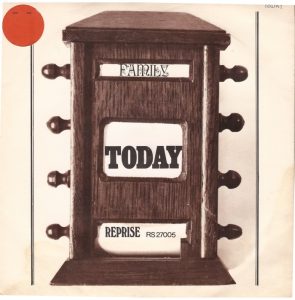


Reader comments — 1970 (1)
Memories, corrections, and additions for 1970. Add yours below.
Hello,
I saw Family perform in Groningen, the Netherlands, in a concert hall called ‘De Harmonie.”
I’m not sure about the date, but I’m 100% convinced John Weider played bass guitar and violin, so it must have been somewhere etween the spring of 1969 and the summer of 1971.
It was one of my first three concerts (the others being Soft Machine and Pink Floyd), and I loved it, despite being terribly loud.
Can anybody tell me when the Groningen concert took place?
Gert van Akkeren